

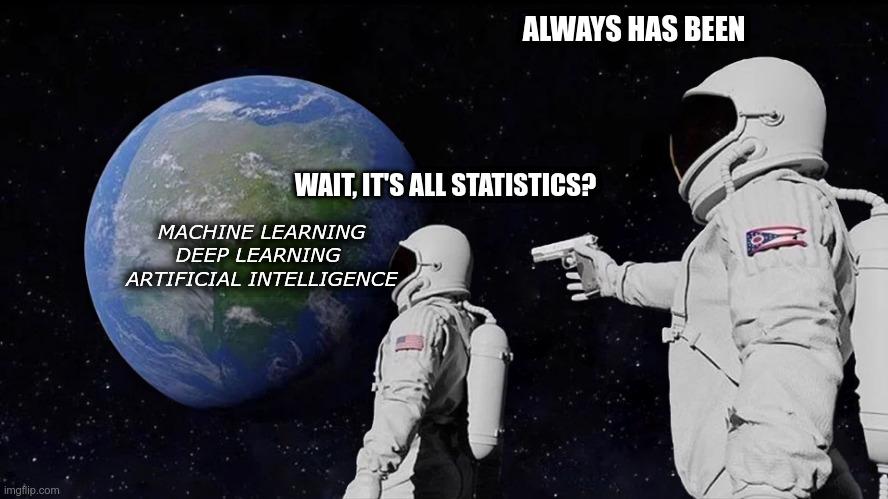
Screen reader caption for blind and visually impaired people: two astronauts out in space with planet Earth in the background. The one at the center, looking towards the Earth says “Machine learning, deep learning, artificial intelligence. Was it all statistic?”. The second one, pointing a gun towards the other’s back responds “Always has been”. Photo by imgflip.com
This post is the spin-off to a conversation I had about a month ago with a small group of current and former long-term volunteers (some turned staff) during the 2023’s International Committee Meeting of Service Civil International (SCI). Your gratitude and support can be directed to the generous, fun-working and exceptionally efficient organizing team of this event, SCI Austria.
One of the reason why I keep attending SCI’s annual meetings even now that my research is over, is the family reunion atmosphere. By now, I think I qualify as the weird and feisty spinster auntie, and so I often take breaks from adult conversations and politely ask the kids to join their circles and get updates about the new cool stuff they’re up to.
In one of such circles, the topic was AI and, more specifically, ChatGPT. Not as in “Do you use it?” but as in “How many creative ways have you found to use it?”. One such ways regarded literature reviews for their term papers or other reports, and several tips and routines were shared and contended before my turn to speak spontaneously came.
Digital activist and computer scientist Joy Buolamwini condensed in a three minute video poem the evidence of AI’s racial and gender bias in facial recognition, and I had my own minute-long rally about the same technology being trained to put together quantitatively justified lists of resources. Spoiler alert, they too systematically reproduce a well known hierarchy: the one having AI masters’ at the top – the male, pale and stale ones. So, it’s political.
The good news is that, as everything human-made and political, a critical discourse and a practice of resistance can be organized, collectively and individually, to turn the hierarchy on its head. In the specific case of literature review, these are the three “OPS!” steps I came up with so far:
- Origin: find the oldest available resource making use of the keyword, idea, topic, concept or debate you’re after. ASK (structurally) WHY that concept could find its way to publication at that specific, time and place, by that author and publisher, and with that wording.
- Prestige: find the currently most cited, the hip piece of research carrying the debate. ASK (structurally) WHY in current times that very piece of research is the catchy, the prestigious, the recognizable and recognized one.
- Subvert: screen for at least one recent contribution through decentralizing, decolonial, trans-feminist, compensatory lens. ASK (structurally) WHY it took longer or it was harder for the authors to get to participate in that debate from their own standpoint.
Note: along the way, you may also stumble upon resources that expressed the same idea without the flashy marketing the currently prestigious contributor had access to, or whose authors were structurally excluded by publishing or obtaining other forms of academic credit.
! – The exclamation point of the OPS! formula comes when we cite them all but order and formulate our citation according to transitional and compensatory.
See?
This is what a human brain can do and is for. Automate this! 😉

 noprofitideas.org