A template for your “Period Leave” auto-responder.

On Period Leave, and why it matters and belongs here.

Screen reader caption for blind and visually impaired people: a pitch black night sky with a huge red full moon shaded on the left side.Photo by GEORGE DESIPRIS on Pexels.com

A decolonial checklist for your decolonial online event. PART 1/2.

Screen reader caption for blind or visually impaired people: A small river zig-zagging into the jungle and forming three increasingly big waterfalls as it comes towards a small, crystal clear pond. There is a small wooden bridge on the upper-left side of the photo, almost invisible, deep in the jungle. Research shows that even short interactions with natural scenery, including pictures and audio recordings can improve human mood and well being. And, oh we’ll need some, when talking colonial stuff! Photo by Rifqi Ramadhan on Pexels.com

Lately, the term “Decolonize” has finally been removed from the unwritten censorship lists by the Committee of White Tears or something. No longer hushed in outrage during classes, conferences and webinars, it is now the buzzing term being probably fed to ChatGPT by lecturers and various organizers so that is now buzzing all around. I should know, I’m in a Decolonize Think Tank [this page is under maintenance], trying to Decolonize International Voluntary Service [project description]! And since the EU is now “updating” its funding strategy to the Cold War and non-EU participants won’t be allowed in any longer (very decolonial) you can start by supporting the International Solidarity Fund of CCIVS (the Coordinating Committee of International Voluntary Service), the umbrella organization who open the discussion about the need for the International Voluntary Service movement to be more intentional, vocal and active about decolonial intentions, talks and practice. As usual, mention ≠ absolute endorsement.

Indeed, saying that an institution, project, exhibition or event are “Decolonial”, does not automatically make it decolonial. I know, shocker. And, sure, a checklist will absolutely solve the problem for good.

Bear with me with a little story. When I was about 18, I communicated to my parents that I had received a supportive ok go from our family doctor to go vegetarian. Me and Dr. Pinecone - the best rendering of the Roman dialect nickname we gave him – devised a one year transition plan starting with reducing meat and fish consumption to twice a week each. “That’s not even a thing – my Mother saidwe already do that“. One week and one dutifully compiled checklist later, we knew that the actual amount was nine times cumulatively – because, yes, bacon and ragù are meat and tuna is fish too. So, yes, we are in therapy now and, yes, I like checklists: this is the second here and won’t be the last 😉

1 – TIME ZONES

Speakers, facilitators and participants are made aware of the schedule according to their own time zone from the moment they are invited and at all times, consistently, throughout communications.

Pro-tip, a.k.a. would you dare?
Have Euro-Americans speak, chair or facilitate at 10pm or later, for once.

2 – SPEAKERS, CHAIRS&FACILITATORS

These are the people that are put on the banner, at the center, on a chair, on a stage, on a full screen, or that are given the mic. Choose wisely, critically, “reparatively”, not quantitatively. “Best-selling”, “most published/established/famous”, “decades-long research holder” … often are synonyms of the pale-male-stale – oh my, PMS! – trinity. If you want to “ensure diversity” but still include the PMS – not ready for an all BIPOC, all-neuro-divergent, all-queer, all-women panel? Why? – ensure they have the elegance and sense of humor to take a damn joke about the true fact that they graduated the same year the first woman was ever admitted in their department.

Pro-tip, a.k.a. would you dare?
Have someone who completely challenges your comfortable and streamlined organizing. Give them unconditional trust and negotiation power, and pay them well.

3 – GENERAL PROMOTION AND VISUAL

In short: visibility and representation matter. This includes but is surely not limited to:

  • The order (first to last, center to margin, top to bottom) of the speakers on all promotional materials. Does it reproduce colonial hierarchies?
  • The wording of each speaker’s written bio, the way they are introduced before they speak, the way they are addressed during the discussion. Do they reproduce colonial tropes?
  • The speaking time, the amount of time each speakers is addressed, the speech support devices they are provided or accessible to them (slides, screen-sharing, video-sharing …), the content of their speech. Is it counter-balancing the exclusion, dispossession and abuse of colonial times?
  • The imagery produced before, during and after. Is it reproducing colonial imagery?

Pro-tip, a.k.a. would you dare?
Would you dare to use each decolonial event to collectively train or re-train, participants and organizers alike?

And speaking of training …

[Continue to PART 2/2]

DECOLONIZE.

Screen reader caption for blind or visually impaired people: An unidentified body of water, it could be a broad river, a lake or the photo could have been taken from a boat approaching the shore. There is a line of hills visible at the horizon, and beautiful clouds are colored by the last rays of the sun that has disappeared already. Research shows that even short interactions with natural scenery, including pictures and audio recordings can improve human mood and well being. And, oh we’ll need some, when talking colonial stuff! Photo by InstaWalli on Pexels.com


One of the ongoing tasks of the Decolonize Think Tank [this page is under maintenance] I am lucky to be a member of, other than trying to Decolonize International Voluntary Service [project description], is to find quick, simple and accessible ways to talk about the century-long, complex and challenging colonial imperialism process. I’ll talk more about this and share ways to support this initiative, the EU is now “updating” its funding strategy to the Cold War and non-EU participants won’t be allowed in any longer – very decolonial. You can start by supporting the International Solidarity Fund of CCIVS (the Coordinating Committee of International Voluntary Service), the umbrella organization who open the discussion about the need for the International Voluntary Service movement to be more intentional, vocal and active about decolonial intentions, talks and practice. As usual, mention ≠ absolute endorsement.

In the past two years, the decolonial conversations was introduced and hosted in groups that systematically had participants who heard the word for the first time, participants that associated the call to decolonize with “decolonisation” (the Cold War program of European colonists formally leaving various African states territories and recognizing independence), and participants that mastered decolonial language, discourse and practice at various degrees – or thought they did, or taught hosts who thought they did 😉

This quote is the least challenged opening so far to these conversations – and is now part of a Decolonial Self-Assessment Tool’s first draft, that should see the light in a couple of months, so it serves as teaser:


[…] a lot of the damage done by imperial colonialism has to do with the creation and (often violent) imposition of a power structure, i.e. a hierarchy of places and people. Some places and people were placed at the bottom of the hierarchy and pictured as lacking power, resources, knowledge, initiative and value; others were put at the top and called powerful, wealthy and valuable. This hierarchy is still visible in today’s world system, […]. Those descending from men-made, wealth-seeking, lighter skinned empires and their allies also tend to dominate the organization and progress of non-decolonized volunteering programs, resulting in a similar hierarchy of empowerment among volunteering organizers and participants.

The logic of the following questions is to keep in mind this hierarchy, and seeing as many chances as possible to turn this hierarchy upside down, in a collective effort to repair and compensate for the damage done.


Intersectionality.

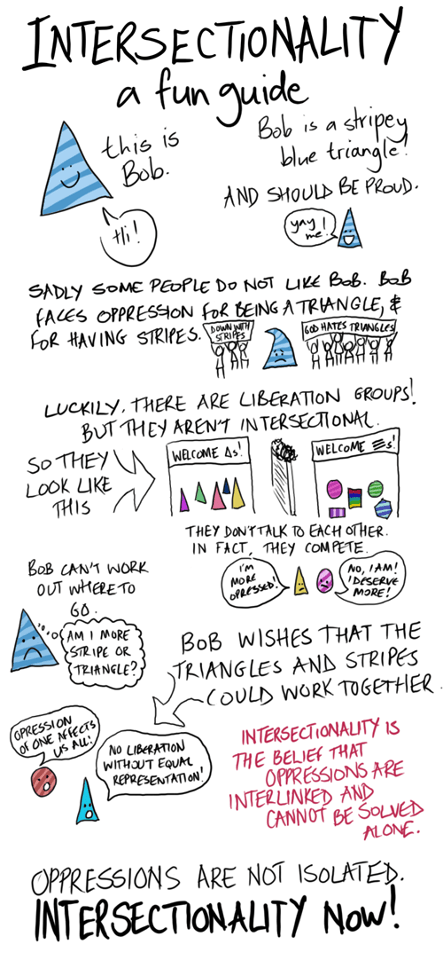
Screen reader caption for bling and visually impaired people: Info-graphic by Miriam Dobson, image description from anotherangrywoman’s blog.

This is an infographic featuring text and descriptions

TITLE: INTERSECTIONALITY: A FUN GUIDE

1. A drawing of a triangle with a smiley face. The triangle is two shades of blue striped. A speech bubble comes from his mouth saying “Hi”. It is captioned “This is Bob”.

2. Caption: “Bob is a stripey blue triangle AND SHOULD BE PROUD.” Bob has a speech bubble saying “YAY ME”.

3. Caption: “SOME PEOPLE DO NOT LIKE BOB. BOB FACES OPPRESSION FOR BEING A TRIANGLE AND FOR HAVING STRIPES” Image of Bob with a sad face, positioned between stick figures holding a sign saying “Down with stripes” and another set of stick figures holding a sign saying “Down with triangles”.

4. Caption: “LUCKILY THERE ARE LIBERATION GROUPS! BUT THEY AREN’T INTERSECTIONAL. SO THEY LOOK LIKE THIS” An arrow points to two rooms, separated by a barbed wire fence. A room with a sign saying “welcome triangles” with triangles inside of many different solid colours. A room with a sign saying “welcome stripes” featuring many different shapes with stripes.

5. Caption: “BOB CAN’T WORK OUT WHERE TO GO”. Bob has a sad face. His thought bubble says “Am I more of a stripe, or a triangle?”

6. Caption: “THEY DON’T TALK TO EACH OTHER. IN FACT THEY COMPETE”. A solid yellow triangle with a cross face is next to a pink striped circle with a cross face. The solid yellow triangle says “I’m more oppressed”. The pink striped circle says “No! I am! I deserve more!”

7. Caption: “BOB WISHES TRIANGLES AND STRIPES COULD WORK TOGETHER”. An arrow points to a red striped circle with an open mouth, and a solid blue triangle with an open mouth. The red striped circle says “Oppression of one affects us all”. The solid blue triangle says “No liberation without equal representation”.

8. Text, in red: “INTERSECTIONALITY IS THE BELIEF THAT OPPRESSIONS ARE INTERLINKED AND CANNOT BE SOLVED ALONE”.

9. Text, in black: “OPPRESSIONS ARE NOT ISOLATED! INTERSECTIONALITY NOW”.


SIMPLY PUT is a category that collects successes in doing a difficult but crucial thing: translating complex and theoretical ideas in a few sharp sentences, making it immediately available for analytical and practical use. The success is especially enjoyable when collectively mediated in a logic of redistribution, for example in an assembly of diverse people, some of which have had access to the term or concept at hand in theory or practice, and offer it to participants who have been – until then – excluded from its fruition. It was the case of “intersectionality” during last October’s NonUnaDiMeno Italy (website in Italian) national assembly in Florence, organized by the Florence chapter or NonUnaDiMeno (Facebook page in Italian), the transnational fourth-wave, trans-feminist movement born in Argentina as NiUnaMenos (website in Spanish) against every form of patriarchal violence and oppression.

A straightforward way to make “Intersectionality” available to anyone in a quick format, is to retrace the story that brought this term to light.

In 1989, professor, activist and legal scholar Kimberlé Crenshaw offers intersectionality as a response to recurring circumstances she notes in labor discrimination trials between employees and American women racialized as Black – and penalizing the latter.

Companies’ defense would highlight, for example, that among their employees there are both women, and people racialized as Black. Crenshaw counters that, in such cases, hired women were White and employed with traditionally (we would now say stereotypically) White “female” duties, such as front desk related ones. On the other hand, hired people racialized as Black were men and employed with (stereotypical) Black male duties, such as physically demanding ones.

The discrimination of women racialized as Black, therefore, took place at the intersection between the “woman” and “Black” identities, where the claimants stood. In Crenshaw’s words (1989, p. 149):

I am suggesting that Black women can experience discrimination in ways
that are both similar to and different from those experienced by
white women and Black men. Black women sometimes experience
discrimination in ways similar to white women’s experiences; some-
times they share very similar experiences with Black men. Yet
often they experience double-discrimination-the combined effects
of practices which discriminate on the basis of race, and on the
basis of sex. And sometimes, they experience discrimination as
Black women-not the sum of race and sex discrimination, but as
Black women.

Putting on our intersectionality lens allows us to analyze and organize from a place of ever-increasing inclusion, because we can take into consideration The System’s oppressing dimensions – class, race, sex/gender, sexual orientation, ability, neurotipicality, species … – as well as those groups and individuals that, if unheard, could fall into the cracks between these dimensions.


REFERENCES

Crenshaw, Kimberle. “Demarginalizing the Intersection of Race and Sex: A Black Feminist Critique of Antidiscrimination Doctrine, Feminist Theory, and Antiracist Politics [1989].” article [Download pdf here]

Organizational privilege check

Screen reader caption for blind and visually impaired people: the upper left corner of a paper sheet reading “Checklist”, followed by a list of empty squares and dotted lines. Photo credit: Openverse.

This open source privilege checklist for organizations (or collectives, co-ops, communities …) is like that lucky child – and not the unlucky teenager – who has a whole village as parents. I tried to rebuild its history, starting from conversations taking place way before its publication on this etherpad, you can make your own here for free. The idea was to assign credit to us all, but in the end, as many parents do, I realized that our choice of leaving it free and alive out there in the world is the best legacy and recognition we could ask for. You can use it, share it, add something (please don’t delete), comment or get in touch if you have questions. These are excerpts.

[If you don’t know what privilege checks are, you can start with this video of a privilege check organized by a teacher for his students in an anonymous way, this is one that doesn’t provide anonymity. If participants’ express their consent – through an anonymous vote – it may be ok to organize a privilege check without assuring anonymity to the participants.]

***WARNING!!!*** 

– Individual privilege checks should be done anonymously because, for ex. you don’t want people to “come out” in front of others such as colleagues, bosses, teachers or classmates, or minorities to feel responsible to educate others about their experience with oppression, while already having to live and deal with oppression.You can decide how to handle anonymity in advance: like, deciding we’re never going to share our personal “scores”, or writing them down on a piece of paper and tossing it in a box that a facilitator will dig in it to then report to the group verbally or on a board.

Examples of privilege checklists in English

(the context of reference in the examples below is Euro-American)

[The organizational privilege check is divided in sections, here is one random yes/no question per section, and reflection prompts. The idea is that one organization, collective or community can use this tool internally as a self-assessment or discussion topic. Additionally, two organizations, collectives or communities that are familiar with this tool, will have a common language to discuss their structural advantages and disadvantages and become allies in fighting against them along their other collaborative activities.]

Structure and decision making

– We can rely on a good number of committed volunteers
  > an organization with fewer volunteering members may be use more resources to hire people and may be penalized in collaboration with an organization that has many and requires equal number or participants to function.

Legal

– We have the opportunity to register legally without negative consequences
 > an organization that has the chance to register legally may be unaware of the fact that this is not the case for all in a certain context and especially across different ones. The non-legally registered one may be barred from participating in institutionalized projects, grants and funding opportunities, awards and recognition.

Finance&Assets

– In our context there is a reliable infrastructure for electricity/plumbing/internet/heating&AC
 > an organization operating in a context with reliable infrastructure may not realize the additional logistical challenges that an organization who doesn’t have this privilege faces in participating, organizing or hosting a certain activity.

Political

– We work in a context where it is safe to talk about “peace”, “human rights”, “sex/gender/sexual orientation”
 > freedom of speech is taken for granted until its taken. Organizations that have to navigate authoritarian or otherwise oppressive contexts may be additionally discriminated in (or excluded by) collaborations taking for granted advertisement and reporting that could cost legal charges to their members.

Cultural

– In the context where we operate, most of the people can find the time to volunteer
 > labor rights and national educational curricula can significantly affect organizations’ staff and volunteers. If two organizations start a collaboration without having an honest conversation about working and schooling hours, working and schooling days, working and schooling holidays, their mutual viewpoint when discussing logistic can be inaccessible

Inclusion

– We have the time to discuss, understand, process and reflect on the topics mentioned in this list.
 > the opportunity structure of each organization shapes their daily activities, office dynamics, the content of lunch break conversations, the language of reference for those conversations …

Take a look at the rest of this tool 🙂

POWER TO THE LITTLE ONES!!!_Part III_On all-nighters, a.k.a. the ultimate team effort.

Screen reader caption for blind or visually impaired people: the opening sentence reads “Man, staying up all night doesn’t affect you?”, the monster doll Glen from 2004 movie “Seed of Chucky” replies: “Nope, look at me, fresh as a daisy”. Photo credit: @memers.media

What follows is Part III of an email I sent on 15th November 2020 to the youngest of my cousins, Riccardo. He had just started his first year of university after graduating through the pandemic, we had lost our legendary grandpa Nonno Alfredo just few months prior, and the family would not be reunited for the next two years. So, an email was my best available means to pass on my tradition of giving The Talk to “the little ones”, as they ventured to university as future first generation graduates. This part is also dedicated to another former “little one” among the recipients of this email, a.k.a. my little sister. She would be happy if you could show some Instagram love and $UPPORT to LuchaYSiesta, a community-run and community-funded center for women escaping domestic violence and their children, active since 2008 in our parents’ neighborhood with a library, a tailoring workshop, a garden and a room for screenings, assemblies and other events – I’ll write with and about them soon because they’re facing eviction threats for the 10th time or so >_<


[A necessary premise of collaboration vs. competition …] starting from year 1 of uni, it appeared clear to me and a certain group of colleagues – some still friends now – that you can’t get anywhere by yourself, and that competing makes no sense. In the spirit of unity, during each exam session we would split the work and make a strategic attack plan: lesson with no mandatory attendance were equally shared, notes, tapes, talents and fears have always been pooled, Bolshevik. This, and only this, has carried all of us till the end sane – excluding pre-existing pathologies and peculiarities, and/or heavy drugs matters.

Team up, sweet pea! ❤

ALL-NIGHTERS

Shit happens, unfortunately. So, regardless of all your best will and independently from you, you may find yourself pulling an all-nighter or [hm] helping someone writing their thesis in 48 hours. There are several ways to pull an all-nighter, someway or another, I’ve pulled a couple of ones and this is what I’ve learned:

NEVER ALONE : as I’ve repeated already several times, unity is strength and this is never as true as in all-nighters’ case. To be in a group means sharing the workload, sharing the stress, and usually have some fun with joyful blasphemy.

THE RIGHT PLACE : in order to avoid having to move or facing eviction at 2:00 AM, make sure that the place you choose is “all-nighter-friendly”. No kids or pets around, no roommates coming back home annoyingly drunk in the wee hours, no anxious parents interrupting the work and demanding reports at 1AM on why is it that you got to study last minute and-of-course-it’s-CAUSE-YOUNEVERLISTENTOME! etc. etc.

THE RIGHT FUEL : Provided that your all-nighter will start after dinner, and that food (better savory or fruits) be a constant presence in strategic position other than your working table … you’ll want to be easy with coffee. It must be rationed cautiously. Particularly efficient is the ritual called *Caffè dello Studente* [Italian for: The Student’s Coffee] between 1:30-2AM. This is just a regular coffee prepared by replacing water with coffee in the bottom part of your moka machine [I found a 2 minutes video about it]. The sages would assume two slices of whole wheat bread before consumption, as a “buffer” for this highly corrosive liquid. Ideally you want to take it sugar-free, because sugars have that “down-phase” … but since it tastes like mud and gasoline, you can submerge it with cane sugar counter-balance the down-phase with stress and the existential crisis you may have around 3AM. You know, the one in which you and your companions hug and cry, howling “That [insert appropriate insult] has to die a painful death!”. And then you go back to work.

THE RIGHT MUSIC : I have been curating various playlists along my study years. One of them has been made with the purpose of studying after 11PM [link to Spotify]. Then there is an instrumental one that I play while reading, and another one I called “Queen of Badassdom” to hype up when I’m on the low. [a new one I devised more recently is for each song to be played on repeat, it’s called REPEAT|repeat|reapIT|trip-it … continues …]

Go to Part I | Go to Part II | This is Part III

Why I don’t use AI for literature reviews (hint: it’s political) and what I do instead.

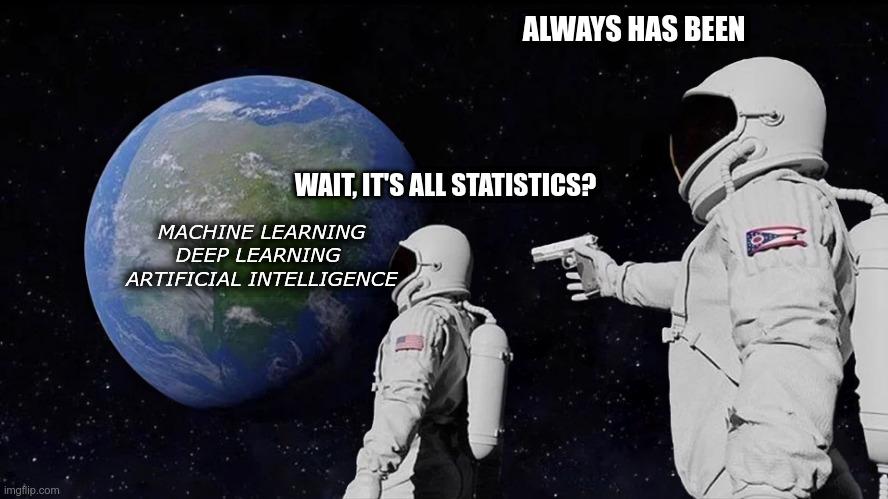
Screen reader caption for blind and visually impaired people: two astronauts out in space with planet Earth in the background. The one at the center, looking towards the Earth says “Machine learning, deep learning, artificial intelligence. Was it all statistic?”. The second one, pointing a gun towards the other’s back responds “Always has been”. Photo by imgflip.com

This post is the spin-off to a conversation I had about a month ago with a small group of current and former long-term volunteers (some turned staff) during the 2023’s International Committee Meeting of Service Civil International (SCI). Your gratitude and support can be directed to the generous, fun-working and exceptionally efficient organizing team of this event, SCI Austria.

One of the reason why I keep attending SCI’s annual meetings even now that my research is over, is the family reunion atmosphere. By now, I think I qualify as the weird and feisty spinster auntie, and so I often take breaks from adult conversations and politely ask the kids to join their circles and get updates about the new cool stuff they’re up to.

In one of such circles, the topic was AI and, more specifically, ChatGPT. Not as in “Do you use it?” but as in “How many creative ways have you found to use it?”. One such ways regarded literature reviews for their term papers or other reports, and several tips and routines were shared and contended before my turn to speak spontaneously came.

Digital activist and computer scientist Joy Buolamwini condensed in a three minute video poem the evidence of AI’s racial and gender bias in facial recognition, and I had my own minute-long rally about the same technology being trained to put together quantitatively justified lists of resources. Spoiler alert, they too systematically reproduce a well known hierarchy: the one having AI masters’ at the top – the male, pale and stale ones. So, it’s political.

The good news is that, as everything human-made and political, a critical discourse and a practice of resistance can be organized, collectively and individually, to turn the hierarchy on its head. In the specific case of literature review, these are the three “OPS!” steps I came up with so far:

  • Origin: find the oldest available resource making use of the keyword, idea, topic, concept or debate you’re after. ASK (structurally) WHY that concept could find its way to publication at that specific, time and place, by that author and publisher, and with that wording.
  • Prestige: find the currently most cited, the hip piece of research carrying the debate. ASK (structurally) WHY in current times that very piece of research is the catchy, the prestigious, the recognizable and recognized one.
  • Subvert: screen for at least one recent contribution through decentralizing, decolonial, trans-feminist, compensatory lens. ASK (structurally) WHY it took longer or it was harder for the authors to get to participate in that debate from their own standpoint.

Note: along the way, you may also stumble upon resources that expressed the same idea without the flashy marketing the currently prestigious contributor had access to, or whose authors were structurally excluded by publishing or obtaining other forms of academic credit.

! – The exclamation point of the OPS! formula comes when we cite them all but order and formulate our citation according to transitional and compensatory.

See?
This is what a human brain can do and is for. Automate this! 😉

HOW TO shorten your meetings by a gazillion.

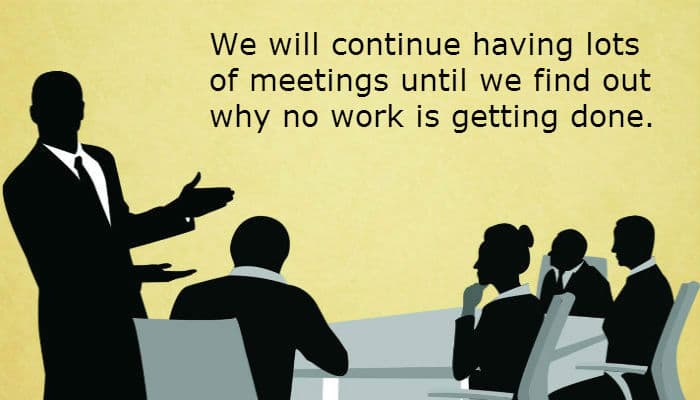
Screen-reader caption for blind or visually impaired readers: faceless people sitting in a meeting, one guy is standing up, facing us, gesturing to indicate he is speaking. The text reads “We will continue having lots of meetings until we find out why no work is being done”. Photo credits: “Meeting Madness” by ecardshack.com.

All the time that activists, volunteers, staff, community members and researchers are sitting in a meeting their are not doing what they’re here for, which is participating into action. Streets are quiet, powerful people are undisturbed in enjoying their privileges, dis-empowered and marginalized ones are lacking support, community spaces are not being held, Nature is not being protected, fairies and unicorns are sobbing and loosing their wings. So, how about … NOT? Or, at least, SHORTER. Among many generous groups of people that allowed me to witness, participate, organize, host, tape, transcribe and analyze group-centered (i.e. horizontal, democratic and inclusive) meeting management, this bit is dedicated to the former – and yet somehow still living students’ collective that brought meetings from weekly to monthly, from endless to less than two hours, and from draining to fun and meaningful – 山城角樂 Happy Corner, mention does not mean absolute endorsement, especially not the documentary.

If your reaction is “But meetings are so useful! They’re the best part! I love them!” you can stop reading – or maybe seek help for yourself and/or your companions. If you wonder how they did it, the no-BS golden rule number zero is “Making it a regular practice”. But keep reading for three additional highlights and tips.

  1. Make it a regular practice_Organizational needs can vary, but groups of people will always need to get familiar with each other, forge a common language to share information, exchange ideas, make decisions, plan action, negotiate roles and responsibilities, hold spaces and emotions, building trust, skills and capacity, and manage expectations or conflicts. Finding the sweet spot between timing and duration, hosting and agenda set-up, and inclusive, emotionally-sensitive content and flow is a collective trial and error journey that every group has to undertake if it is to thrive.
  2. Timing and duration_The first question to ask each other is a blunt “Do we even need to meet?”. Meetings can be replaced by short messages, one-on-ones or strategically invited smaller group talks. If the meeting is to happen, and regularly so, you can start from a weekly 90 minutes (5 minutes video from the Huberman Lab podcast), or biweekly or monthly, and negotiate your way down from there – for example aiming at 45 minutes weekly or 90 minutes monthly. Regular timing saves a lot of time, communication and decision fatigue: as in every Monday, every second Tuesday, or every last Wednesday of the month. If you want to exceed the 90 minutes time-slot – but why?! – make sure to plan for 15-20 minutes moving and off-screen breaks.
  3. Hosting and agenda_When every team member regularly organizes and hosts meetings on a rotation basis, workload and valuable skills are shared among participants, and a spirit of solidarity and cooperation is likely to emerge. Similarly, when everyone participates to the agenda setting in a shared document (by timely adding topics and expected discussion time, and taking the lead in that segment of the conversation) momentum is created in view of the meeting and ownership is shared among the participants. Priority can be established by opening every agenda item is open for endorsement, with participants adding a “+” or their name next to a topic they deem more urgent or worth spending more time on.
  4. Diverse, equitable and inclusive_Meetings can highlight organizational power structures and dynamics that, sadly often, match with power structures and dynamics that we see and fight against in the world. Rotational hosting can help the group in spotting practices that exclude certain groups or individuals from fully participating. But, fortunately, creativity is an endless source when it comes to remove the barriers that prevent people from showing up for a meeting, freely expressing their status, needs, opinions, proposals and discontents. Among many devices and tools for inclusions, the group this post is dedicated to created three hand-signs with the specific aim of managing time, energy levels and mood levels in a way that participants found recognizable, useful and fun.

While the first one is used to signal the speaker that they’re going off topic without interrupting verbally. The second and third ones can be called by the speaker to check if the rest of the people need an emotional or energetic lift-up.

Stay on topic

Two hands are held up together in a circle shape. Other participants can literally join hands too until the speaker has received the message.

Energy level

A man with a sad face holds his hand in front of his forehead doing a loser sign. He may be sad because his energy level response is 2 out of 5.

Mood level

A woman smiles holding her hand on her heart. She may be smiling because her mood level is 5 out of 5.

POWER TO THE LITTLE ONES!!!_Part II_On citations.

Me, et al.


Screen reader caption for blind and visually impaired people: a snow capped mountain range top emerges through the clouds. Photo by eberhard grossgasteiger on Pexels.com]


What follows is Part II of an email I sent on 15th November 2020 to the youngest of my cousins, Riccardo. He had just started his first year of university after graduating through the pandemic, we had lost our legendary grandpa Nonno Alfredo just few months prior, and the family would not be reunited for the next two years. So, an email was my best available means to pass on my tradition of giving The Talk to “the little ones”, as they ventured to university as future first generation graduates. This part is also dedicated to another former “little one” among the recipients of this email, my architect cousin Arianna. She would be happy if you could follow and show some love to the urban regeneration adventure – or “urban acupuncture” – she is taking part in @needlecrowd – mention does not equate absolute endorsement.

[… continues from Part I … ] I found a very short article (6 pages) with very good pictures. I use it to show you a Google Scholar function you can use: citations.

If you type the title of this article on Google Scholar, the article doesn’t come out per se because it is not an academic article – meaning published by an academic journal after a peer review done by other scholars – but since it has been cited once somewhere it comes out as “[citation]” [in black].

So you can – and this is valid for any article, book or material on Google Scholar – click on the “Cite” button with quotes that you see below the article’s title, next to the little star accompanying the “Save” button. This way you can see all the details you have to include in your citation to avoid committing plagiarism.

ATTENTION! A window will pop up, showing official citation styles: MLA (devised by the Modern Language Association), APA (by the American Psychological Association), Chicago (as in University of Chicago), Harvard (it goes without saying), Vancouver (guess?). And how do we choose? 

First, by subject: in sociology or philosophy APA, Chicago e Harvard, are more frequently used. But it depends on who is the recipient of what you write, some professors have their own favorite. In architecture, too … But given the complication of having to cite architectural works, projects and drawings, I’ve found a quite complete guide on how to do just that. [the original link of this email is now behind a membership-only curtain – thanks Virginia Tech, you kinda suck! So here’s one for images, and another framework of reference that can be valid for buildings, design objects, and art pieces]

Second: I use Chicago because other styles in which the author’s name is reduced to a punctuated initial are more subjected to confusion, and can be discriminatory for authors whose surname is very common. This is particularly the case for surnames from areas of the world in which languages are not written in Latin letters, and surnames are numerically fewer than in other languages (see for example, China). 

If you cite material that you found on a website, other than all information [like author, title, webpage name, date of publication and URL] you should also add “Accessed on: …” and adding the date of your last access.

If, instead, you find an academic article on Google Scholar that has been cited already more than once and can be downloaded – click on the link to the title’s right to download, if it’s not accessible from your institution let me know 😉 – the title will be in blue and with no “[citation]” before the title. In this case, to the right of the quotes icon ” you’ll find “Cited by” and the amount of citations that article has received. Clicking on “Cited by” you’ll get to a chronological list of all the publications the article has been cited by, so they can be on the same topic but more updated because they’ve been published more recently. [ … continues …]

Go to Part I | This is Part II