
A decolonial checklist for your decolonial online event. PART 1/2.

Screen reader caption for blind or visually impaired people: A small river zig-zagging into the jungle and forming three increasingly big waterfalls as it comes towards a small, crystal clear pond. There is a small wooden bridge on the upper-left side of the photo, almost invisible, deep in the jungle. Research shows that even short interactions with natural scenery, including pictures and audio recordings can improve human mood and well being. And, oh we’ll need some, when talking colonial stuff! Photo by Rifqi Ramadhan on Pexels.com

Lately, the term “Decolonize” has finally been removed from the unwritten censorship lists by the Committee of White Tears or something. No longer hushed in outrage during classes, conferences and webinars, it is now the buzzing term being probably fed to ChatGPT by lecturers and various organizers so that is now buzzing all around. I should know, I’m in a Decolonize Think Tank [this page is under maintenance], trying to Decolonize International Voluntary Service [project description]! And since the EU is now “updating” its funding strategy to the Cold War and non-EU participants won’t be allowed in any longer (very decolonial) you can start by supporting the International Solidarity Fund of CCIVS (the Coordinating Committee of International Voluntary Service), the umbrella organization who open the discussion about the need for the International Voluntary Service movement to be more intentional, vocal and active about decolonial intentions, talks and practice. As usual, mention ≠ absolute endorsement.

Indeed, saying that an institution, project, exhibition or event are “Decolonial”, does not automatically make it decolonial. I know, shocker. And, sure, a checklist will absolutely solve the problem for good.

Bear with me with a little story. When I was about 18, I communicated to my parents that I had received a supportive ok go from our family doctor to go vegetarian. Me and Dr. Pinecone - the best rendering of the Roman dialect nickname we gave him – devised a one year transition plan starting with reducing meat and fish consumption to twice a week each. “That’s not even a thing – my Mother saidwe already do that“. One week and one dutifully compiled checklist later, we knew that the actual amount was nine times cumulatively – because, yes, bacon and ragù are meat and tuna is fish too. So, yes, we are in therapy now and, yes, I like checklists: this is the second here and won’t be the last 😉

1 – TIME ZONES

Speakers, facilitators and participants are made aware of the schedule according to their own time zone from the moment they are invited and at all times, consistently, throughout communications.

Pro-tip, a.k.a. would you dare?
Have Euro-Americans speak, chair or facilitate at 10pm or later, for once.

2 – SPEAKERS, CHAIRS&FACILITATORS

These are the people that are put on the banner, at the center, on a chair, on a stage, on a full screen, or that are given the mic. Choose wisely, critically, “reparatively”, not quantitatively. “Best-selling”, “most published/established/famous”, “decades-long research holder” … often are synonyms of the pale-male-stale – oh my, PMS! – trinity. If you want to “ensure diversity” but still include the PMS – not ready for an all BIPOC, all-neuro-divergent, all-queer, all-women panel? Why? – ensure they have the elegance and sense of humor to take a damn joke about the true fact that they graduated the same year the first woman was ever admitted in their department.

Pro-tip, a.k.a. would you dare?
Have someone who completely challenges your comfortable and streamlined organizing. Give them unconditional trust and negotiation power, and pay them well.

3 – GENERAL PROMOTION AND VISUAL

In short: visibility and representation matter. This includes but is surely not limited to:

  • The order (first to last, center to margin, top to bottom) of the speakers on all promotional materials. Does it reproduce colonial hierarchies?
  • The wording of each speaker’s written bio, the way they are introduced before they speak, the way they are addressed during the discussion. Do they reproduce colonial tropes?
  • The speaking time, the amount of time each speakers is addressed, the speech support devices they are provided or accessible to them (slides, screen-sharing, video-sharing …), the content of their speech. Is it counter-balancing the exclusion, dispossession and abuse of colonial times?
  • The imagery produced before, during and after. Is it reproducing colonial imagery?

Pro-tip, a.k.a. would you dare?
Would you dare to use each decolonial event to collectively train or re-train, participants and organizers alike?

And speaking of training …

[Continue to PART 2/2]

HOW TO shorten your meetings by a gazillion.

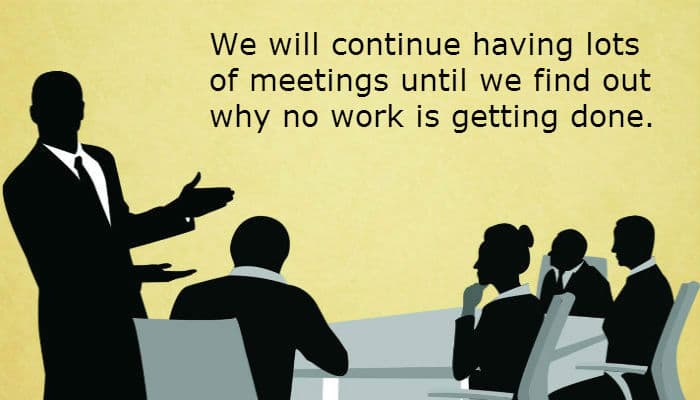
Screen-reader caption for blind or visually impaired readers: faceless people sitting in a meeting, one guy is standing up, facing us, gesturing to indicate he is speaking. The text reads “We will continue having lots of meetings until we find out why no work is being done”. Photo credits: “Meeting Madness” by ecardshack.com.

All the time that activists, volunteers, staff, community members and researchers are sitting in a meeting their are not doing what they’re here for, which is participating into action. Streets are quiet, powerful people are undisturbed in enjoying their privileges, dis-empowered and marginalized ones are lacking support, community spaces are not being held, Nature is not being protected, fairies and unicorns are sobbing and loosing their wings. So, how about … NOT? Or, at least, SHORTER. Among many generous groups of people that allowed me to witness, participate, organize, host, tape, transcribe and analyze group-centered (i.e. horizontal, democratic and inclusive) meeting management, this bit is dedicated to the former – and yet somehow still living students’ collective that brought meetings from weekly to monthly, from endless to less than two hours, and from draining to fun and meaningful – 山城角樂 Happy Corner, mention does not mean absolute endorsement, especially not the documentary.

If your reaction is “But meetings are so useful! They’re the best part! I love them!” you can stop reading – or maybe seek help for yourself and/or your companions. If you wonder how they did it, the no-BS golden rule number zero is “Making it a regular practice”. But keep reading for three additional highlights and tips.

  1. Make it a regular practice_Organizational needs can vary, but groups of people will always need to get familiar with each other, forge a common language to share information, exchange ideas, make decisions, plan action, negotiate roles and responsibilities, hold spaces and emotions, building trust, skills and capacity, and manage expectations or conflicts. Finding the sweet spot between timing and duration, hosting and agenda set-up, and inclusive, emotionally-sensitive content and flow is a collective trial and error journey that every group has to undertake if it is to thrive.
  2. Timing and duration_The first question to ask each other is a blunt “Do we even need to meet?”. Meetings can be replaced by short messages, one-on-ones or strategically invited smaller group talks. If the meeting is to happen, and regularly so, you can start from a weekly 90 minutes (5 minutes video from the Huberman Lab podcast), or biweekly or monthly, and negotiate your way down from there – for example aiming at 45 minutes weekly or 90 minutes monthly. Regular timing saves a lot of time, communication and decision fatigue: as in every Monday, every second Tuesday, or every last Wednesday of the month. If you want to exceed the 90 minutes time-slot – but why?! – make sure to plan for 15-20 minutes moving and off-screen breaks.
  3. Hosting and agenda_When every team member regularly organizes and hosts meetings on a rotation basis, workload and valuable skills are shared among participants, and a spirit of solidarity and cooperation is likely to emerge. Similarly, when everyone participates to the agenda setting in a shared document (by timely adding topics and expected discussion time, and taking the lead in that segment of the conversation) momentum is created in view of the meeting and ownership is shared among the participants. Priority can be established by opening every agenda item is open for endorsement, with participants adding a “+” or their name next to a topic they deem more urgent or worth spending more time on.
  4. Diverse, equitable and inclusive_Meetings can highlight organizational power structures and dynamics that, sadly often, match with power structures and dynamics that we see and fight against in the world. Rotational hosting can help the group in spotting practices that exclude certain groups or individuals from fully participating. But, fortunately, creativity is an endless source when it comes to remove the barriers that prevent people from showing up for a meeting, freely expressing their status, needs, opinions, proposals and discontents. Among many devices and tools for inclusions, the group this post is dedicated to created three hand-signs with the specific aim of managing time, energy levels and mood levels in a way that participants found recognizable, useful and fun.

While the first one is used to signal the speaker that they’re going off topic without interrupting verbally. The second and third ones can be called by the speaker to check if the rest of the people need an emotional or energetic lift-up.

Stay on topic

Two hands are held up together in a circle shape. Other participants can literally join hands too until the speaker has received the message.

Energy level

A man with a sad face holds his hand in front of his forehead doing a loser sign. He may be sad because his energy level response is 2 out of 5.

Mood level

A woman smiles holding her hand on her heart. She may be smiling because her mood level is 5 out of 5.