

DECOLONIZE.

Screen reader caption for blind or visually impaired people: An unidentified body of water, it could be a broad river, a lake or the photo could have been taken from a boat approaching the shore. There is a line of hills visible at the horizon, and beautiful clouds are colored by the last rays of the sun that has disappeared already. Research shows that even short interactions with natural scenery, including pictures and audio recordings can improve human mood and well being. And, oh we’ll need some, when talking colonial stuff! Photo by InstaWalli on Pexels.com


One of the ongoing tasks of the Decolonize Think Tank [this page is under maintenance] I am lucky to be a member of, other than trying to Decolonize International Voluntary Service [project description], is to find quick, simple and accessible ways to talk about the century-long, complex and challenging colonial imperialism process. I’ll talk more about this and share ways to support this initiative, the EU is now “updating” its funding strategy to the Cold War and non-EU participants won’t be allowed in any longer – very decolonial. You can start by supporting the International Solidarity Fund of CCIVS (the Coordinating Committee of International Voluntary Service), the umbrella organization who open the discussion about the need for the International Voluntary Service movement to be more intentional, vocal and active about decolonial intentions, talks and practice. As usual, mention ≠ absolute endorsement.

In the past two years, the decolonial conversations was introduced and hosted in groups that systematically had participants who heard the word for the first time, participants that associated the call to decolonize with “decolonisation” (the Cold War program of European colonists formally leaving various African states territories and recognizing independence), and participants that mastered decolonial language, discourse and practice at various degrees – or thought they did, or taught hosts who thought they did 😉

This quote is the least challenged opening so far to these conversations – and is now part of a Decolonial Self-Assessment Tool’s first draft, that should see the light in a couple of months, so it serves as teaser:


[…] a lot of the damage done by imperial colonialism has to do with the creation and (often violent) imposition of a power structure, i.e. a hierarchy of places and people. Some places and people were placed at the bottom of the hierarchy and pictured as lacking power, resources, knowledge, initiative and value; others were put at the top and called powerful, wealthy and valuable. This hierarchy is still visible in today’s world system, […]. Those descending from men-made, wealth-seeking, lighter skinned empires and their allies also tend to dominate the organization and progress of non-decolonized volunteering programs, resulting in a similar hierarchy of empowerment among volunteering organizers and participants.

The logic of the following questions is to keep in mind this hierarchy, and seeing as many chances as possible to turn this hierarchy upside down, in a collective effort to repair and compensate for the damage done.

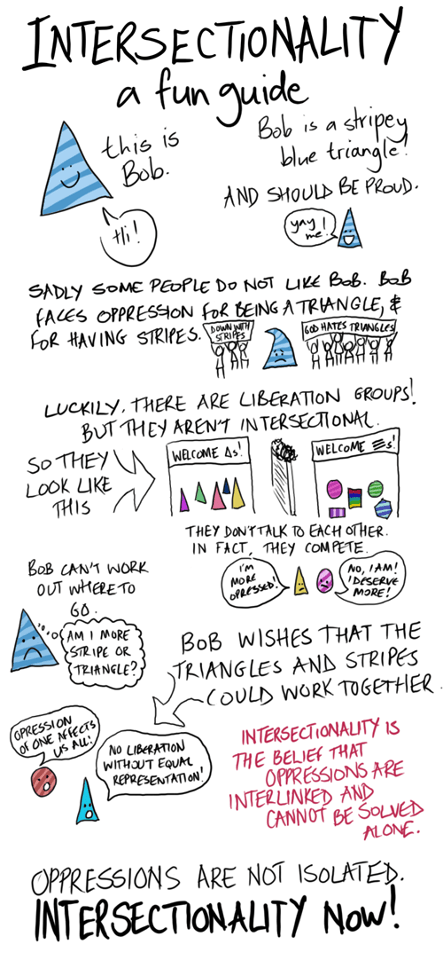


Intersectionality.

Screen reader caption for bling and visually impaired people: Info-graphic by Miriam Dobson, image description from anotherangrywoman’s blog.

This is an infographic featuring text and descriptions

TITLE: INTERSECTIONALITY: A FUN GUIDE

1. A drawing of a triangle with a smiley face. The triangle is two shades of blue striped. A speech bubble comes from his mouth saying “Hi”. It is captioned “This is Bob”.

2. Caption: “Bob is a stripey blue triangle AND SHOULD BE PROUD.” Bob has a speech bubble saying “YAY ME”.

3. Caption: “SOME PEOPLE DO NOT LIKE BOB. BOB FACES OPPRESSION FOR BEING A TRIANGLE AND FOR HAVING STRIPES” Image of Bob with a sad face, positioned between stick figures holding a sign saying “Down with stripes” and another set of stick figures holding a sign saying “Down with triangles”.

4. Caption: “LUCKILY THERE ARE LIBERATION GROUPS! BUT THEY AREN’T INTERSECTIONAL. SO THEY LOOK LIKE THIS” An arrow points to two rooms, separated by a barbed wire fence. A room with a sign saying “welcome triangles” with triangles inside of many different solid colours. A room with a sign saying “welcome stripes” featuring many different shapes with stripes.

5. Caption: “BOB CAN’T WORK OUT WHERE TO GO”. Bob has a sad face. His thought bubble says “Am I more of a stripe, or a triangle?”

6. Caption: “THEY DON’T TALK TO EACH OTHER. IN FACT THEY COMPETE”. A solid yellow triangle with a cross face is next to a pink striped circle with a cross face. The solid yellow triangle says “I’m more oppressed”. The pink striped circle says “No! I am! I deserve more!”

7. Caption: “BOB WISHES TRIANGLES AND STRIPES COULD WORK TOGETHER”. An arrow points to a red striped circle with an open mouth, and a solid blue triangle with an open mouth. The red striped circle says “Oppression of one affects us all”. The solid blue triangle says “No liberation without equal representation”.

8. Text, in red: “INTERSECTIONALITY IS THE BELIEF THAT OPPRESSIONS ARE INTERLINKED AND CANNOT BE SOLVED ALONE”.

9. Text, in black: “OPPRESSIONS ARE NOT ISOLATED! INTERSECTIONALITY NOW”.


SIMPLY PUT is a category that collects successes in doing a difficult but crucial thing: translating complex and theoretical ideas in a few sharp sentences, making it immediately available for analytical and practical use. The success is especially enjoyable when collectively mediated in a logic of redistribution, for example in an assembly of diverse people, some of which have had access to the term or concept at hand in theory or practice, and offer it to participants who have been – until then – excluded from its fruition. It was the case of “intersectionality” during last October’s NonUnaDiMeno Italy (website in Italian) national assembly in Florence, organized by the Florence chapter or NonUnaDiMeno (Facebook page in Italian), the transnational fourth-wave, trans-feminist movement born in Argentina as NiUnaMenos (website in Spanish) against every form of patriarchal violence and oppression.

A straightforward way to make “Intersectionality” available to anyone in a quick format, is to retrace the story that brought this term to light.

In 1989, professor, activist and legal scholar Kimberlé Crenshaw offers intersectionality as a response to recurring circumstances she notes in labor discrimination trials between employees and American women racialized as Black – and penalizing the latter.

Companies’ defense would highlight, for example, that among their employees there are both women, and people racialized as Black. Crenshaw counters that, in such cases, hired women were White and employed with traditionally (we would now say stereotypically) White “female” duties, such as front desk related ones. On the other hand, hired people racialized as Black were men and employed with (stereotypical) Black male duties, such as physically demanding ones.

The discrimination of women racialized as Black, therefore, took place at the intersection between the “woman” and “Black” identities, where the claimants stood. In Crenshaw’s words (1989, p. 149):

I am suggesting that Black women can experience discrimination in ways
that are both similar to and different from those experienced by
white women and Black men. Black women sometimes experience
discrimination in ways similar to white women’s experiences; some-
times they share very similar experiences with Black men. Yet
often they experience double-discrimination-the combined effects
of practices which discriminate on the basis of race, and on the
basis of sex. And sometimes, they experience discrimination as
Black women-not the sum of race and sex discrimination, but as
Black women.

Putting on our intersectionality lens allows us to analyze and organize from a place of ever-increasing inclusion, because we can take into consideration The System’s oppressing dimensions – class, race, sex/gender, sexual orientation, ability, neurotipicality, species … – as well as those groups and individuals that, if unheard, could fall into the cracks between these dimensions.


REFERENCES

Crenshaw, Kimberle. “Demarginalizing the Intersection of Race and Sex: A Black Feminist Critique of Antidiscrimination Doctrine, Feminist Theory, and Antiracist Politics [1989].” article [Download pdf here]