POWER TO THE LITTLE ONES!!!_Part III_On all-nighters, a.k.a. the ultimate team effort.

Screen reader caption for blind or visually impaired people: the opening sentence reads “Man, staying up all night doesn’t affect you?”, the monster doll Glen from 2004 movie “Seed of Chucky” replies: “Nope, look at me, fresh as a daisy”. Photo credit: @memers.media

What follows is Part III of an email I sent on 15th November 2020 to the youngest of my cousins, Riccardo. He had just started his first year of university after graduating through the pandemic, we had lost our legendary grandpa Nonno Alfredo just few months prior, and the family would not be reunited for the next two years. So, an email was my best available means to pass on my tradition of giving The Talk to “the little ones”, as they ventured to university as future first generation graduates. This part is also dedicated to another former “little one” among the recipients of this email, a.k.a. my little sister. She would be happy if you could show some Instagram love and $UPPORT to LuchaYSiesta, a community-run and community-funded center for women escaping domestic violence and their children, active since 2008 in our parents’ neighborhood with a library, a tailoring workshop, a garden and a room for screenings, assemblies and other events – I’ll write with and about them soon because they’re facing eviction threats for the 10th time or so >_<


[A necessary premise of collaboration vs. competition …] starting from year 1 of uni, it appeared clear to me and a certain group of colleagues – some still friends now – that you can’t get anywhere by yourself, and that competing makes no sense. In the spirit of unity, during each exam session we would split the work and make a strategic attack plan: lesson with no mandatory attendance were equally shared, notes, tapes, talents and fears have always been pooled, Bolshevik. This, and only this, has carried all of us till the end sane – excluding pre-existing pathologies and peculiarities, and/or heavy drugs matters.

Team up, sweet pea! ❤

ALL-NIGHTERS

Shit happens, unfortunately. So, regardless of all your best will and independently from you, you may find yourself pulling an all-nighter or [hm] helping someone writing their thesis in 48 hours. There are several ways to pull an all-nighter, someway or another, I’ve pulled a couple of ones and this is what I’ve learned:

NEVER ALONE : as I’ve repeated already several times, unity is strength and this is never as true as in all-nighters’ case. To be in a group means sharing the workload, sharing the stress, and usually have some fun with joyful blasphemy.

THE RIGHT PLACE : in order to avoid having to move or facing eviction at 2:00 AM, make sure that the place you choose is “all-nighter-friendly”. No kids or pets around, no roommates coming back home annoyingly drunk in the wee hours, no anxious parents interrupting the work and demanding reports at 1AM on why is it that you got to study last minute and-of-course-it’s-CAUSE-YOUNEVERLISTENTOME! etc. etc.

THE RIGHT FUEL : Provided that your all-nighter will start after dinner, and that food (better savory or fruits) be a constant presence in strategic position other than your working table … you’ll want to be easy with coffee. It must be rationed cautiously. Particularly efficient is the ritual called *Caffè dello Studente* [Italian for: The Student’s Coffee] between 1:30-2AM. This is just a regular coffee prepared by replacing water with coffee in the bottom part of your moka machine [I found a 2 minutes video about it]. The sages would assume two slices of whole wheat bread before consumption, as a “buffer” for this highly corrosive liquid. Ideally you want to take it sugar-free, because sugars have that “down-phase” … but since it tastes like mud and gasoline, you can submerge it with cane sugar counter-balance the down-phase with stress and the existential crisis you may have around 3AM. You know, the one in which you and your companions hug and cry, howling “That [insert appropriate insult] has to die a painful death!”. And then you go back to work.

THE RIGHT MUSIC : I have been curating various playlists along my study years. One of them has been made with the purpose of studying after 11PM [link to Spotify]. Then there is an instrumental one that I play while reading, and another one I called “Queen of Badassdom” to hype up when I’m on the low. [a new one I devised more recently is for each song to be played on repeat, it’s called REPEAT|repeat|reapIT|trip-it … continues …]

Go to Part I | Go to Part II | This is Part III

HOW TO shorten your meetings by a gazillion.

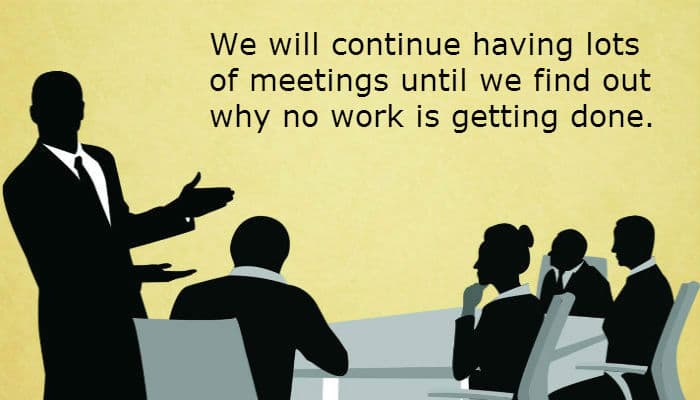
Screen-reader caption for blind or visually impaired readers: faceless people sitting in a meeting, one guy is standing up, facing us, gesturing to indicate he is speaking. The text reads “We will continue having lots of meetings until we find out why no work is being done”. Photo credits: “Meeting Madness” by ecardshack.com.

All the time that activists, volunteers, staff, community members and researchers are sitting in a meeting their are not doing what they’re here for, which is participating into action. Streets are quiet, powerful people are undisturbed in enjoying their privileges, dis-empowered and marginalized ones are lacking support, community spaces are not being held, Nature is not being protected, fairies and unicorns are sobbing and loosing their wings. So, how about … NOT? Or, at least, SHORTER. Among many generous groups of people that allowed me to witness, participate, organize, host, tape, transcribe and analyze group-centered (i.e. horizontal, democratic and inclusive) meeting management, this bit is dedicated to the former – and yet somehow still living students’ collective that brought meetings from weekly to monthly, from endless to less than two hours, and from draining to fun and meaningful – 山城角樂 Happy Corner, mention does not mean absolute endorsement, especially not the documentary.

If your reaction is “But meetings are so useful! They’re the best part! I love them!” you can stop reading – or maybe seek help for yourself and/or your companions. If you wonder how they did it, the no-BS golden rule number zero is “Making it a regular practice”. But keep reading for three additional highlights and tips.

  1. Make it a regular practice_Organizational needs can vary, but groups of people will always need to get familiar with each other, forge a common language to share information, exchange ideas, make decisions, plan action, negotiate roles and responsibilities, hold spaces and emotions, building trust, skills and capacity, and manage expectations or conflicts. Finding the sweet spot between timing and duration, hosting and agenda set-up, and inclusive, emotionally-sensitive content and flow is a collective trial and error journey that every group has to undertake if it is to thrive.
  2. Timing and duration_The first question to ask each other is a blunt “Do we even need to meet?”. Meetings can be replaced by short messages, one-on-ones or strategically invited smaller group talks. If the meeting is to happen, and regularly so, you can start from a weekly 90 minutes (5 minutes video from the Huberman Lab podcast), or biweekly or monthly, and negotiate your way down from there – for example aiming at 45 minutes weekly or 90 minutes monthly. Regular timing saves a lot of time, communication and decision fatigue: as in every Monday, every second Tuesday, or every last Wednesday of the month. If you want to exceed the 90 minutes time-slot – but why?! – make sure to plan for 15-20 minutes moving and off-screen breaks.
  3. Hosting and agenda_When every team member regularly organizes and hosts meetings on a rotation basis, workload and valuable skills are shared among participants, and a spirit of solidarity and cooperation is likely to emerge. Similarly, when everyone participates to the agenda setting in a shared document (by timely adding topics and expected discussion time, and taking the lead in that segment of the conversation) momentum is created in view of the meeting and ownership is shared among the participants. Priority can be established by opening every agenda item is open for endorsement, with participants adding a “+” or their name next to a topic they deem more urgent or worth spending more time on.
  4. Diverse, equitable and inclusive_Meetings can highlight organizational power structures and dynamics that, sadly often, match with power structures and dynamics that we see and fight against in the world. Rotational hosting can help the group in spotting practices that exclude certain groups or individuals from fully participating. But, fortunately, creativity is an endless source when it comes to remove the barriers that prevent people from showing up for a meeting, freely expressing their status, needs, opinions, proposals and discontents. Among many devices and tools for inclusions, the group this post is dedicated to created three hand-signs with the specific aim of managing time, energy levels and mood levels in a way that participants found recognizable, useful and fun.

While the first one is used to signal the speaker that they’re going off topic without interrupting verbally. The second and third ones can be called by the speaker to check if the rest of the people need an emotional or energetic lift-up.

Stay on topic

Two hands are held up together in a circle shape. Other participants can literally join hands too until the speaker has received the message.

Energy level

A man with a sad face holds his hand in front of his forehead doing a loser sign. He may be sad because his energy level response is 2 out of 5.

Mood level

A woman smiles holding her hand on her heart. She may be smiling because her mood level is 5 out of 5.

POWER TO THE LITTLE ONES!!!_Part I_The basics

This photo of Famiglie Arcobaleno [Rainbow FamiliesDonate!] organization’s flags is exhibit A of my dad’s full recovery from internalized homophobia. He took it last Saturday, as he marched at Roma Pride parade.
It does get better!

What follows is part I of an email I sent on 15th November 2020 to the youngest of my cousins, Riccardo. He had just started his first year of university after graduating through the pandemic, we had lost our legendary grandpa Nonno Alfredo just few months prior, and the family would not be reunited for the next two years. So, an email was my best available means to pass on my tradition of giving The Talk to “the little ones” , as they ventured to university as future first generation graduates. Now that he is venturing his last exam session before graduation – CONGRATS! – he would be happy if you could direct your love and attentions to this young musician here – mention does not equate absolute endorsement.

Ciao bellezza! 😎

It took me until Sunday find a moment and knock out an updated version of my “POWER TO THE LITTLE ONES!” starters-pack … which, I realize now, is starting to get a little bit long … like a letter! But no worries, you can look at it little by little 🙂 Even because, in the past, this passage of information would happen, indeed, little by little as we would gather together … now we’ve got to adapt.

PRELIMINARY ISSUES

So, the assumption is that certain things you might have already acquired in your past 20 years … but let’s refresh ten essential points in semi-random order:

  1. 7-8 hours of good quality sleep per night, scheduling days of to rest … and rewards for when you accomplish something, anything;
  2. Eat “well-combed” … a.k.a. properly! … which is very subjective. But I am still to meet a person who tells me that they get by eating red meat, sugar and process food throughout an exam session. A good indicator other than clinical symptoms is: if you managed to have a focused study session after eating X, X is your friend.
  3. Drink a lot of water. Easy with caffeine – see exceptions later* – and keep alcohol and moderate hallucinators for the weekend … speaking of which …
  4. Avoid synthetic drugs, or “natural” ones coming from the Amazon Forest, or the Andean highlands: let’s remember where we live.
  5. Breathe with your belly and keep calm. Do not quit physical activity.
  6. Don’t stop being in contact with Nature, and with yourself – which is the same thing.
  7. Don’t ever lose contact with friends, those who make you feel all positive and energetic and relaxed etc. after you meet.
  8. Don’t ever quit learning things that have no (apparent) connection with your course of study – such as languages and technical skills.
  9. Avoid jerks, and caring about their jerkiness – same for toxic, negative or energy-draining subjects.
  10. Reserve a specific time and place to screens and social media – like, not in bed, or before 9am, or after 10pm etc.

If you’re good with this, 50% is done and you’re my new personal hero 🙂

Before we put (vegan) flesh on this basic structure, note: if you want to delve into any of the topics mentioned above, you can find agile videos on Youtube. But watch it: because I got to the point that one-two hours of each day ended up being dedicated to “productivity videos” … and that’s a little bit much. [… continues …]

Go to Part II |